

Is high-performance linear?
Last weekend’s sporting action has made us curious about seemingly natural ‘cycles of high-performance’ in sport and has prompted us to question, ‘are these same cycles present in organisations?’. Check this out…
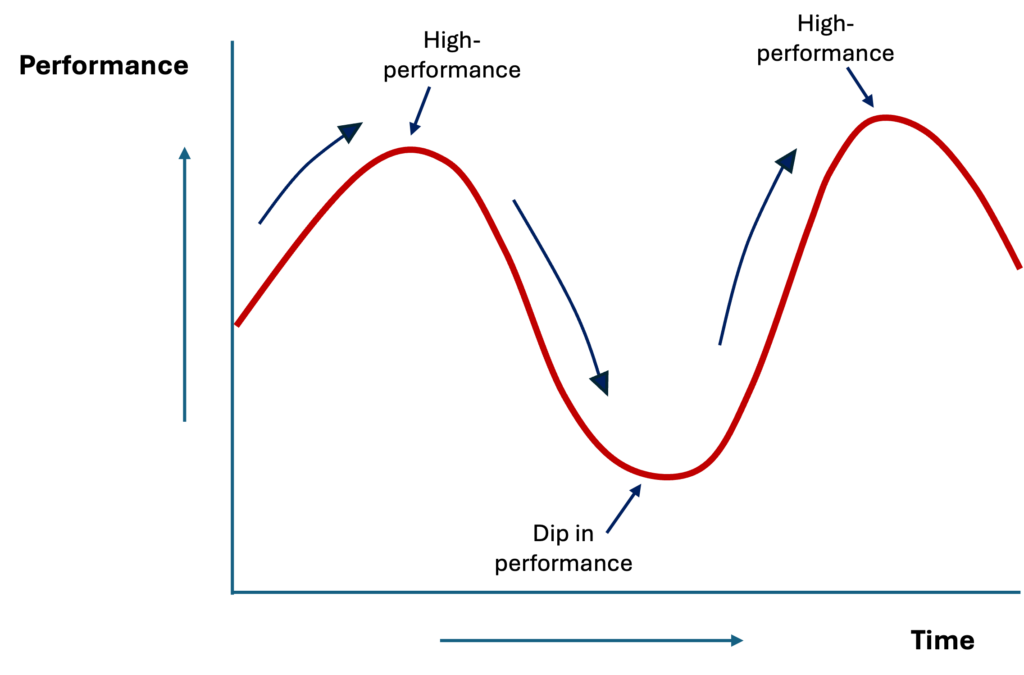
For rugby fans out there, it has been unbelievable to see the Welsh rugby team go from being ranked as the second-best team in the World in 2019, to 11th in World ranking tables today. We are regularly reminded by the media that Wales have lost 21 of their past 23 international rugby matches, and their dominant era seems, to all commentators, to be over… for now. The team had a long period of high-performance and dominance but, as the more experienced players have retired or been sidelined due to injury, the younger players have simply not been able to make the same impact. How much is this a symptom of the reported downturn in the level of investment in junior pathways and club rugby, leading to slim pickings at national level? There is no doubt that this will change again in future, but for now the Welsh rugby team are firmly in the ‘dip’ in their cycle of performance.
Meanwhile, the British Skeleton team find themselves very close to the top of their high-performance cycle, after dipping at the 2022 Beijing Olympics. Some readers may remember that Lizzy Yarnold won Gold in Skeleton in both 2014 and 2018, and the Brits also won two Bronze medals in the 2018 Olympics. They left Pyeongchang on a high, full of optimism for the 2022 Games in Beijing, but it was not to be. Their lack of competitiveness four years ago was largely blamed on faulty and slow equipment, as well as a younger, less experienced squad. With two Golds awarded to British Skeleton athletes in Milan Cortina 2026, it is clear that lessons were learned and revisions made, to bring them back up the performance curve. Perhaps they heeded the words of Henry Ford, “Failure is simply the opportunity to begin again, this time more intelligently”
There are many other examples in sporting history of teams or individuals moving up and down the curve of high-performance: Leicester City FC, the Golden State Warriors, Ferrari F1, Tiger Woods…. Who else can you name? Let us know!
Given that this cycle seems so common in sport, our thoughts turned to whether it is also common in organisations. The obvious differentiator here is that most businesses that experience a downturn in fortunes find it difficult to stay profitable and ultimately crumple or get eaten under the market pressures (who remembers Blockbuster or Toys ‘R’ Us?). However, there are some examples of turnarounds that we might be able to learn from:
Lego
In the late 1990s / early 2000s, Lego was experiencing hugely reduced demand and had so many products that there was no longer a clear offering for customers. They were sliding down our performance curve and struggling to climb back up again. Until, that is, they decided to return to their core brick system as their main product and asked fans for input and ideas to expand their product range. This got customers engaged again and excitement building for the possibilities that Lego offered. The climb up the performance curve began to gain momentum and they didn’t look back.
Virtual Coach insights: Lego put a specific focus on its core purpose and its core offering to guide strategy and performance. Keeping purpose central to decision making supports the future-proofing of organisations.
Burberry
Burberry was originally created as a ‘luxury’ brand and retailer, and successfully retained this image until the 1990s when counterfeits started appearing on the market, product quality started to be inconsistent, and the brand was diluted due to over-licensing. A turnaround was needed which meant that the organisation doubled down on their visual identity and branding campaigns, re-centring the brand around its authentic heritage – trench coats, British craftmanship, and luxury outerwear – and made it very visible digitally.
Virtual Coach insights: Burberry defended what they were distinctively great at, and re-built their performance around their core strengths, rather than chasing competitors down avenues that didn’t align with their competencies. They were one of the first to offer live-streamed runway shows and to experiment with digital story telling in the fashion arena. They had the courage to do this because these new digital opportunities were closely linked to their heritage.
What is clear from these examples, both sporting and organisational, is that high-performance and excellence are rarely linear. Reductions in competitiveness are very likely to occur, driven by external factors, skills gaps, budgets or other players in the market, but as long as we have built strong foundations and we maintain focus around our core purpose or heritage, any dips in performance will be followed by an upward trend in performance.
This is why we reference purpose and values in almost every performance session that we run! You’re In Cool Company…