Today’s insights come from bike racing!
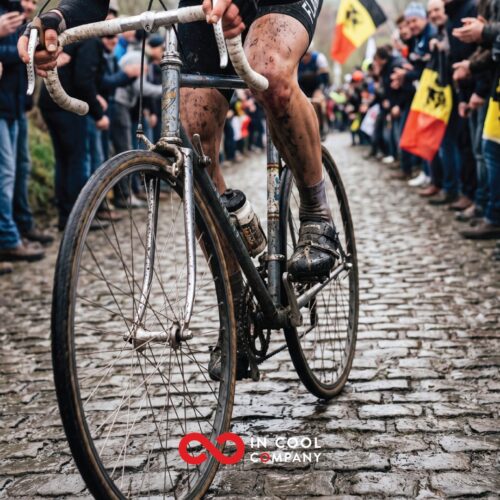
Last Sunday, the 123rd edition of the iconic Paris-Roubaix bike race took place. This is a 258km point-to-point race which famously includes 54km of gruelling cobblestones, spread out over 30 sectors.
Amongst cyclists, the race is often referred to as ‘The Hell of the North’ because in the high-speed chaos of cobblestones, anything can happen. There are more punctures, mechanicals, and crashes in this race than any other on the circuit. Finishing is by no means guaranteed and winning is equal in stature to winning a stage of the Tour de France.
Tadej Pogacar is the reigning world and Tour de France champion. When he is on a start line, there is an expectation that he is the one to beat, his sheer presence is intimidating. But a Paris-Roubaix victory has so far evaded him. Would 2026 be his year?
After more than 250km, interspersed with the usual chaos, the win came down to a sprint finish. Wout van Aert vs. Tadej Pogacar, racing side by side around the centuries-old Roubaix velodrome. The 2026 result will go down in history. Wout van Aert managed to outsprint the awesome Tadej Pogacar to claim his first victory in six years. He never stopped trying, and when he finally created the opportunity, he took it.
Why are we telling you about this? Because Van Aert’s win is a powerful metaphor for organisational leadership, resilience and long-term vision. His post-race comments underscore key themes that we discuss regularly in leadership programmes: perseverance through volatility, the value of experience, staying committed to a long-term goal, and performing under pressure.
So today, we’ve distilled Van Aert’s win into some leadership lessons that we might all take time to consider. Settle in:
- Long‑Term Vision Matters
In his post-race interviews, Van Aert made clear that winning Paris-Roubaix has been a “goal since 2018”, tied deeply to emotional motivation after losing teammate Michael Goolaerts in that year’s race. He described the 2026 win as “a dream” he never stopped pursuing.
Leadership lesson:
Great leaders hold a vision that outlasts short‑term results. Even when performance dips or outcomes don’t materialise immediately, that long-term vision provides meaning, structure, direction, and emotional connection for teams when leaders hold it steady. It’s normally packaged as ‘Purpose’.
- Experience Accumulates
Van Aert acknowledged that repeated setbacks in this race over the years brought him “experience” that ultimately enabled his win. In previous editions, he faced punctures, crashes and sheer bad luck, and still noted that these experiences provided the perfect knowledge required to finally succeed.
Leadership lesson:
Every organisational setback has the ability to de-rail plans and leave teams disappointed and de-motivated. However, setbacks can also be capability building. Teams that take time to debrief their failures, extract learning, and build on those experiences eventually outperform those who don’t. It’s not just the getting back up that counts, it’s the analysis of the fall in the first place.
3. Staying Composed Pays Dividends
Paris–Roubaix is famous for chaos: unpredictable crashes, cobbles, dust, punctures, and constant reshuffling of the leaders. The 2026 edition was described as “one of the most chaotic and attritional” in recent memory. Despite suffering a puncture with 70km to go and losing the lead group temporarily, Van Aert stayed calm, fought back, and kept himself in contention, ultimately taking the win.
Leadership lesson:
Organisational environments have variables that shift regularly: budgets change, competitors disrupt the market, materials increase in price, and internal challenges arise. The best leaders guide their teams through all these variables with composure and adaptability, leading with a calmness that their teams then imitate. Remember us talking about ‘Casting a Shadow’?
5. Success Requires Trusting the Plan Under Pressure
Van Aert noted in his post-race interview that once he reached the velodrome for the final sprint, he didn’t hear the roar of the crowd because he was totally focussed and “just stuck to (his) plan,” relying on the mental rehearsal he’d done many times, despite the huge pressure and global TV audience.
Leadership lesson:
In high‑pressure moments, such as major pitches or critical negotiations, success often comes from disciplined preparation. Practice, planning and visualisation create clarity when the stakes are high and helps individuals and teams to ‘trust the process’.
6. Success Is Shared – Not Individual
Across his interviews, Van Aert repeatedly dedicated his victory to the late Michael Goolaerts (who suffered a fatal cardiac arrest in the 2018 Paris-Roubaix race), to his teammates, past staff, and the organisation’s leadership who never stopped believing that he could win. He emphasised their role as part of his journey and attributed his success to the efforts everyone had invested.
Leadership lesson:
Great leaders understand that wins aren’t theirs alone. Recognising contributions from every corner of the team helps to build loyalty, develop culture, and generate a sense of shared ownership and pride.
Wout van Aert’s long‑awaited victory came from accumulated learning, emotional connection, consistent vision, disciplined preparation, and resilience in the face of repeated disappointments. What a great example to draw learnings from – it is an excellent reminder that success is not linear, but it comes from a commitment to turning chaos into capability.